Showing posts with label #methodtomadness. Show all posts

Friday, July 14, 2017

Defeating Time Bandits (A post about Time Management NOT the movie)

If you love 80’s movies, you might love Time Bandits. I sure do. But I don’t love things that steal my time, you know, the crappy bandits of time. Time is the one commodity that once it passes it’s gone. You can melt gold from jewelry, you might get better growth from pastures if you tend to them and care for them, but time? It is fragile as they come… and easily squandered.

So how do you make the best use of time?

Well firstly, I’m not the best person to ask all the time. Sure, I might be productive, I might at times have frightening stamina (which can and DOES run out), I might get a lot done in a little time, but sometimes I misuse time… I squander it. And when I see what I could have done, it doesn’t feel all too stellar.

Although there are many tips I can offer to address this, I shall focus on one for the moment: identify the bandits of time.

What steals your time? What app is fracturing your attention? What game is keeping you from your goals? What adventures in multi-tasking has you progressing in a way but coming up short?

For me, there are a couple of apps plus ALL the things I want to do. The difference between winging it and organizing myself is staggering. Last week, I had several to-dos, but I didn’t dedicate time, my list was more creative than strict, and I was distracted by bodyboarding competitions, apps, life, and tons of things.

This happens and the first thing we need to do is to be OK with it happening from time to time but without losing focus or giving ourselves all the slack in the world. It’s all about balance and time has a way of flying away from us. That’s why today, my list was a definitive list. It had allotted time to it. It had order. It had structure and it looked formal enough to force me to commit to tackling it. 11 items, plus the day job… and I got it all done. Bit by bit. Steady as she goes. Wasn’t a writer sprint. Wasn’t pushing through an avalanche, it was staying steady, keeping the list nearby, making time, and STICKING to that time. I have 10 minutes? That’s it. If I don’t complete, I leave until tomorrow as punishment.

Now here’s an interesting thing to note. This approach doesn’t always work. Think of it like a sprain or a headache. Sometimes an ice pack helps. Sometimes it’s sleep. Sometimes it’s even getting the right tisane or tea for the job. Inspiration, to do lists, and writing is much the same. It’s an ever evolving challenge and you have to constantly find new ways of facing those challenges and going for it. That’s because sometimes you need to freshen things up and try something new. Too often people focus on tried and true methods and they get painted into a corner.

Don’t fall into that trap. Be creative. Be adventurous. See what works for you. Give yourself tough love. Give yourself tough attitudes. Be accountable. Be whatever the day or week needs you to be but always focus on finding ways to keep going forwards.

For me, it’s all about keeping the phone away and focusing on the task at hand. I did what I wanted to do… and that creates momentum. So here’s to tomorrow. To visualizing that list, to seeing those lines come from your pen or keyboard, and for those other lines to go across each one of those items.


Peace, love, and maki rolls.

Tuesday, February 9, 2016

Method to Madness: Matching music and mood

Most of my adult life I've had music playing on walkmen, discmen, crappy MP3 players, iPods, and my phone. Seeing me in college walking with a pair of headphones on wasn't just par for the course, it was a constant of who I was and still am.

At most jobs, I'd be constantly connected, modifying my mood, getting audible inspiration and motivation to calm down, rev up, work harder, work meticulously, and any variation you can imagine. To say I'm symbiotic with music is a fair, just, and pleasant statement I'll never mind hearing.

So when it comes to writing, music and I work hand in hand... or well hand in ear, but you get what I mean.

My musical choices for writing do vary a lot and it will greatly depend on the mood I am or the mood I need to be for what I want to write. For battle scenes, I won't listen to arias and sonatas, I'm going full blast with something that helps me tap into that inner violence we all have within. That spark that smiles when you see a knockout. Heavy metal music is the perfect choice and of that I have plenty of options including Fear Factory, first album by Slipknot, Rammstein, Slayer, Meshuggah, and Sepultura, just to name a few. For something more spiritual, the moment can dictate the song. I've listened to everything from Tool's more ethereal tracks, to Anathema, Nine Inch Nails, Pearl Jam, Alice in Chains, Sigur Ros, Elbow, classical music, you name it.

But the important thing to remember is that we're all wired differently.

When I was a teen I would go to sleep with Darkside of the Moon and Downward Spiral as if either album was a good option to sleep to, SPOLER ALERT: they're not because of the clocks on Time and the brutal guitars on March of the Pigs. Of note is that I can work with music with lyrics and not let it creep into what I'm writing because I'm able to detach myself from the music just enough to reach that state where you start making up lyrics that have NOTHING to do with what is really being sung but which is exactly what your soul hears beneath the layers of voices.

For something sad, Radiohead, the Cure, Beck, and some albums by the Eels definitely help me to get to that mood. But again, that's me and how I modify my perception and emotional state.

What is definitely certain is that everything I write has the flavor of some type of music and I do think it's a very effective tool to take your brain and heart to meet up with where your story is. It's also a good way of being able to tap into those emotions and later disengage with other music.

I say this because for me, my writing is very personal and it is very kinetic as I write it, meaning it can and does affect me. Sometimes positively, sometimes leaving me with certain emotions that I needed to achieve to write something the way it had to be written. The beauty in this is that when I'm done, I can switch the track and lead my self on an audible journey out of that mood into a better headspace. Sometimes it can be while also doing reflections and deep breathing and other times with a walk.

Whatever the case, music is a part of my life and an essential part of my writing. I love writing to a rhythm and my keyboard goes from being a medium to tap keys to capture my thoughts and words and transforms into its own musical instrument. A percussive communication instrument and yes, sometimes you can get in random stances or really just focus on the keyboard as if it were a piano and vary your keystrokes... but still... there's the music again.

So when you have a story to write or you're working on a novel, try mapping out the plot and the emotions you want to achieve on each chapter. When you have a good idea of where you're going, turn your writing into a road trip and set the playlist that best lets you get on the journey and capture your story, your words, and your emotions.

Who knows? You might find something new in your writing or you may find a better rhythm to work on those stories you like to share.

Peace, love, and maki rolls

Ps.: do you write listening to music? If so, what do you listen to and why?

Tuesday, April 7, 2015

So you want to write a book Part 2: Get to know your characters


Now that you know for sure that you want to write a book, here comes the fun part, writing it.
Writing is one of the things I most enjoy doing in my life. It is equally challenging and liberating.

So why did I take seven years to write Only Human. Ok, here’s the thing, I had the concept down and had begun writing but it took me the longest time to shift from focusing on the craft of writing in favor of allowing myself to be swept by the story.

This sounds simple… it isn’t.

It took me years to have this breakthrough.

I can still remember that moment when providence arrived. I couldn’t stop writing and it is one of the most wonderful experiences I’ve been fortunate enough to enjoy.

Being frank, this is something that happens; it’s not something you can induce but you can make it a whole lot easier on yourself.

First off, get at least two notebooks (or word documents for you digital folk). One is for your work and the other one is for ideas and notes. They are BOTH capture tools but their purpose is endlessly different.

If you’re going for a novel, write down character names and then find out who they are, what do they have to say, why do they do what they do… in essence, what drives them. Do this for heroes and baddies alike. Really DIG into what makes them do the things they do.

In Only Human, Nathaniel Runnels is a jaded average Joe reporter who dreams of writing a novel. He hates his job but there’s reason behind that hate. He found out that he would not do what he wanted to do the most: seek out truth. He likes wine, he’s switched to gin and it’s a wonder he makes ends meet. Both his parents died, he has two brothers, he is agnostic and does tend to go with the flow even though that often means settling. He also always keeps his manners, something that saves his tuckus on more than one occasion.

Daniel of Montacre is a vampire who is over 400 years old. He’s a smartass, plays the violin and isn’t keen on being tied to any stereotype regarding vampires. He has been in love with Captain Jane Rivers for over half his existence and is driven by his need to save humanity so the entire world doesn’t collapse. He trusts very few people, always prepares in advance and a long life has given him the skill of supreme foresight, farther reaching than anyone could imagine.

You could say I fleshed out these characters but the reality is actually more organic. On more than one occasion I’ve crossed something off a page because Daniel would never say something like that. You know these people because although they might be characters captured in words… they’re alive. They have feelings. They have fears. They exist within.

On more than one occasion, I’ve meditated and tried to channel Daniel, to know him more in depth. It also goes deeper than just knowing a character…. It’s having a relationship with them. I’ve done the same with other characters and when in doubt, I’ve audibly asked them questions only to have my hand jot down the answer.

Spooky? You bet. But that’s how writing works sometimes; you just have to let your hand go sometimes.

By fully appreciating the nuances of each character, you get to write something that feels that much more real…. And you know why it feels that much more real?

Because it is.

Monday, February 9, 2015

So you want to write a book Part 1: Why and What

Plenty of people say they want to write a book. Few actually do. 

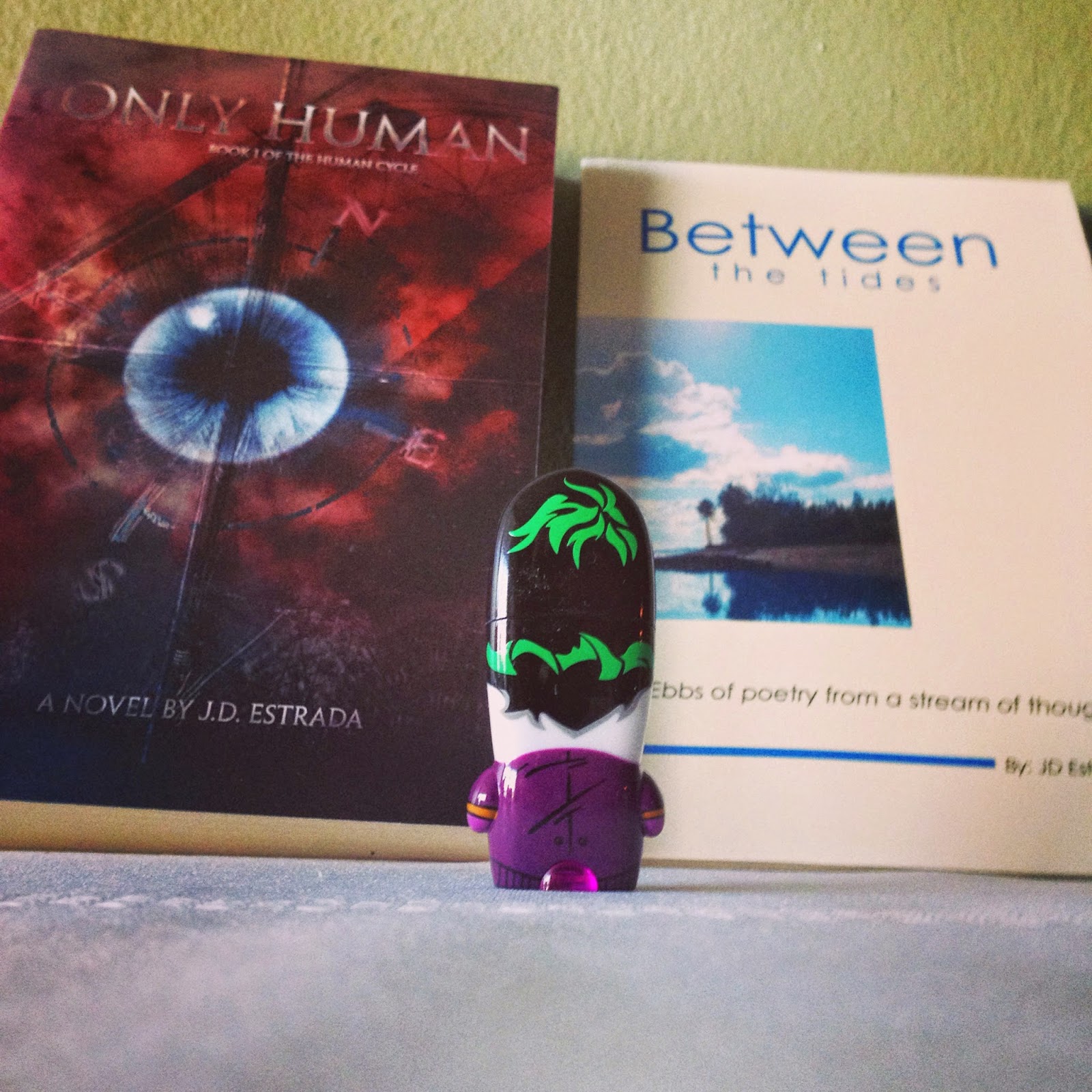
It’s been two years since I published Only Human and in that time, over a hundred people have told me they have a story or that they have an idea for a book. People have been kind enough to ask me for advice, tips and pointers and I always do my best to help out and answer any and all questions that come my way. 

(By all means, if you have a question, email me: jdestradawriter@gmail.com).

So let’s say you want to write a book. The first thing you have to ask yourself is why you want to write a book. If your answer is to make money, get a movie deal or become famous, maybe writing a book isn’t the best option for you, honestly. 

Writing is not an easy way to make a living. It is demanding, draining and is devoid of an exact science. By this, I mean that just because you’re brilliant and a hell of a writer doesn’t guarantee pretty much anything. 

To be honest, I think that if you want to write a book, completing the project should be its own payoff, i.e. Your greatest reward from writing a book is, well… writing a book. Everything else should be a bonus. I say this because if I needed fame and fortune to be satisfied, I’d be under medication right now. By caring about the story and the work, I look past low sales and low engagement. 

Who knows? Maybe your book sells two million copies and becomes an ultra-successful series… but what happens if you only sell two copies? Neither of these outcomes should take away from the fact that you finished a book. 

After asking yourself why you want to write a book, go to the next question: what do you want to say?

If you have something to say, that’ll be what drives your narrative. If instead you want to write a zombie book because they’re selling like hot cakes, ask yourself why you need to sell something that doesn’t really say something that’s true to you. 

Once you've answered these questions, then and ONLY then should you go o the next step to focus on the how.

Something to talk about on our next post.

Cheers

Friday, November 14, 2014

Method to Madness: Those thieving words


Sometimes in the search for the perfect description, we fall prey to using more words than we might have needed to. 

Make no mistake, lush descriptions are amazing and as a writer, I love giving an accurate picture of the worlds within my mind. But if poetry has taught me anything, it’s that sometimes you need a little less words to get a lot more emotion.

Here are three reasons of why this is:

  1. You give the reader the power to create and describe. Some of the best stories I’ve read ask me to fill in some blanks to make the story in my mind. This engages the reader making the story that much more active for them.
  2. Tighter writing. When your story dominates the words on the page rather than long descriptions, it makes it that much harder for a reader to let go of your story.
  3. Your style will flow better and your instinct will take over, dictating when to go hog wild with a description and when to play coy.

As humans, we all communicate and you don’t need to be a writer to know the power of words when you’re communicating a story OR a message.

Thursday, April 17, 2014

Method to madness: what’s my style again?


When it comes to telling a story, the what is essential in the sense that it defines your work, but what will take it to the next level is the how.

Style is essential to success because it is what differentiates you. When people read a book, it’s perfectly fine to see influences although it’s not so cool when it really feels as if it reads as if an author is just trying to emulate someone else. Stylistic plagiarism is just as bad as with content and to be honest, it’s always better to follow what drives you and the topics that inspire you than to write what sells.

Some people have said I did good in writing about vampires in Only Human because vampires are a hot topic, except there’s one catch. I didn’t write a vampire book, I didn’t use a ten bullet point system of things Anne Rice or Stephanie Meyer did, I wrote a book from the gut with topics, characters and scenarios that resonate with me. I just happened to include vampires. In short, I didn’t use someone else’s stylistic map to get to my destination.

So how do you develop your style? That is the end all to writing questions because it’s at the same time the easiest and hardest thing to develop in your skills. It is the easiest because it only asks that you be true to yourself. It’s the hardest for the same reason. Being true to your voice is hard because you will often be invited to write differently, to omit something to tweak something and although good advice and good editing are vital to an excellent story, you have to know when to commit to your vision and your voice regardless of the consequences.

It sounds scary, though honestly it isn’t. It’s only scary at first because you’re not used to it. What you have to ask about your story and how you tell it is one basic question, when people read this and meet you, will they hear your voice, will they see you taking the deliberate time and putting emphasis on the details that matter to you?

I think it’s better to understand this concept through music. If you’ve ever heard Tool, you know that very few bands before them sound like them. Afterwards though? That’s another story.

Take the time to listen to tracks from Tool, tracks by Chevelle and tracks by Earshot. You will see similarities in style and approach (although talent-wise, it’s never a good idea to match up against a band of Tool’s caliber). Still, you see what Chevelle and Earshot are trying to do and although they play their guts out, you see way too much of the influence in their music.

The same goes for writing.

I love Tolkien, Frank Herbert, Neil Gaiman, CS Lewis and JK Rowling; I truly do. Now I would never want to be the next Tolkien, Frank Herbert, Neil Gaiman, CS Lewis or JK Rowling. I am me, JD Estrada, I have my voice and I will not back down from the visions, dreams, nightmares and stories I have to share with you, because neither did they, and neither should you.

Don’t compromise. Write the way you want to write and when in doubt, look to your heart compass and follow the needle wherever it points.